Turning an idea into a fully functional product in 2026 requires more than just coding, it requires a clear mobile app development process. Whether you’re a startup founder or a business owner, understanding the mobile app development process helps reduce costs, save time, and ensure success.
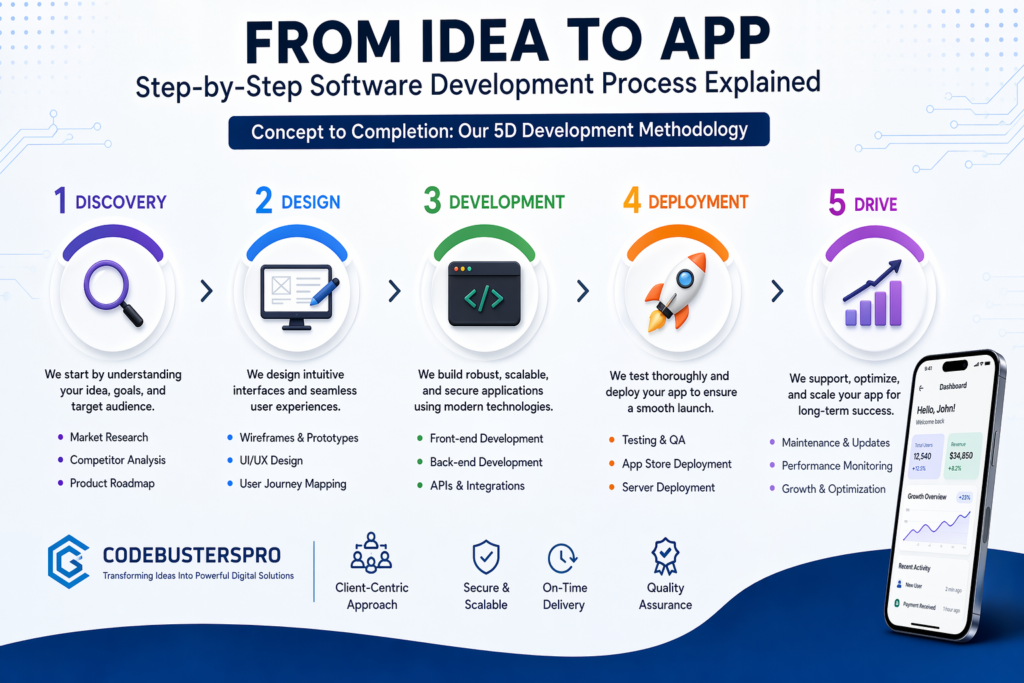
At CodeBustersPro, we simplify the mobile app development process using our proven framework: Concept to Completion: Our 5D Development Methodology.
Mobile App Development Process Step 1: Discovery
Every successful app starts with a clear idea. In the Discovery phase, the goal is to understand your business objectives, target audience, and core features.
This stage includes:
Market research and competitor analysis
Defining user personas
Creating a product roadmap
A well-defined discovery phase ensures your app solves real problems and meets market demand—crucial for long-term success.
Step 2: Design – Crafting User Experience
Once the idea is validated, the next step is designing the app’s interface and user experience (UI/UX).
Key activities include:
Wireframing and prototyping
User journey mapping
Visual design (colors, typography, branding)
A strong design not only makes your app visually appealing but also ensures seamless navigation and higher user engagement.
Mobile App Development Process Step 3: Development
This is where the actual coding begins. The development phase is divided into frontend (what users see) and backend (server, database, APIs).
Depending on your needs, developers may use:
Native development (iOS/Android)
Cross-platform frameworks (Flutter, React Native)
Agile methodologies are commonly used in 2026, allowing continuous improvements and faster delivery through iterative development cycles.
Step 4: Deployment – Launching the Product
After development and rigorous testing, your app is ready to go live.
This stage includes:
App store submission (Google Play & Apple App Store)
Server deployment and configuration
Performance optimization
A smooth deployment ensures your app reaches users without technical issues or delays.
Step 5: Drive & Maintenance – Scaling for Growth
Launching the app is just the beginning. The final phase focuses on growth, updates, and long-term success.
This includes:
Regular updates and bug fixes
Feature enhancements
Performance monitoring
Marketing and user acquisition
Continuous improvement is essential to stay competitive in today’s fast-evolving digital landscape.
Why the 5D Mobile App Development Process Matters
The Concept to Completion: 5D Development Methodology (Discovery, Design, Development, Deployment, Drive) ensures a structured and efficient workflow. It minimizes risks, improves collaboration, and guarantees that every stage of the project aligns with your business goals.
By following this approach, businesses can:
Reduce development costs
Launch faster
Build scalable and user-friendly applications
Final Thoughts
Building an app in 2026 is not just about writing code—it’s about strategy, execution, and continuous improvement. By following a step-by-step development process and leveraging a proven methodology like the 5D framework, you can transform your idea into a successful digital product.
If you’re ready to turn your concept into reality, choosing the right development partner and process is the first step toward success.
Read More About Top 10 Reasons why your business should have a custom web or mobile app.