The AI software development workflow is transforming the modern technology industry. Businesses worldwide are adopting AI software development solutions to automate operations, improve efficiency, and create smarter digital products. From startups to enterprise companies, the demand for artificial intelligence software development is growing rapidly because AI helps organizations save time, reduce costs, and enhance customer experiences.
Today, understanding the AI development process is essential for developers, software engineers, and business owners who want to stay ahead in the digital era. A well-structured machine learning workflow helps companies build intelligent applications that can analyze data, automate tasks, and continuously improve performance.
What Is AI Software Development Workflow?
An AI workflow is a structured process used to design, train, test, deploy, and maintain intelligent software applications. Unlike traditional development methods, these systems depend heavily on data, automation, and advanced learning models.
This process combines software engineering with intelligent technologies to create applications that can learn from user behavior, analyze information, and generate accurate predictions. A well-organized workflow helps ensure reliable performance, scalability, and continuous improvement.
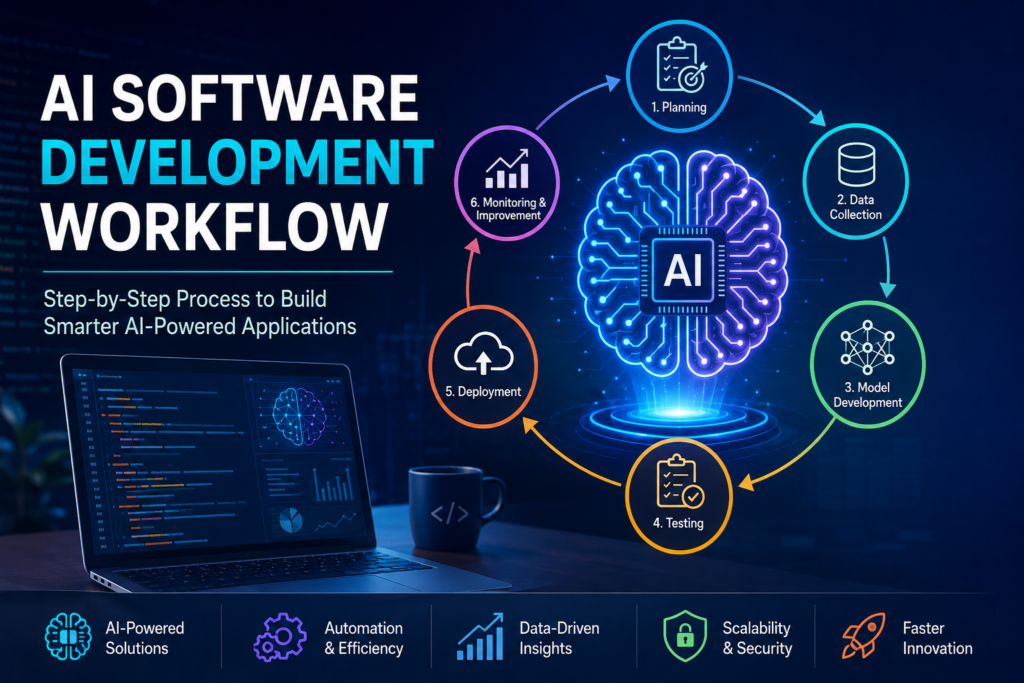
1. Planning the AI Software Development Workflow
The first step in the AI software development workflow is identifying the business problem and planning the solution. During this stage, companies define project goals, target users, and expected outcomes.
The planning phase also includes selecting programming languages, frameworks, cloud platforms, and automation tools. Proper planning improves efficiency and reduces development risks.
Businesses that invest in a strong machine learning workflow during planning are more likely to build scalable and high-performing AI applications.
2. Data Collection
Data is one of the most important elements in the AI software development workflow. High-quality data helps AI systems learn patterns and generate accurate outputs.
In artificial intelligence software development, developers collect data from websites, applications, APIs, customer interactions, and databases. The data is then cleaned, labeled, and transformed for machine learning purposes.
A well-managed machine learning workflow improves prediction accuracy and enhances the performance of AI-powered applications. Without proper data preparation, the entire AI development process can fail.
3. AI Model Development and Machine Learning Workflow
The next stage involves building and training AI models. Developers choose suitable machine learning algorithms based on the project’s goals and software requirements.
Models are trained using historical data so they can identify trends, patterns, and user behavior effectively. Popular frameworks for model training include TensorFlow, PyTorch, and Scikit-learn.
A well-structured workflow helps developers continuously improve model performance, speed, efficiency, and prediction accuracy. This stage plays a major role in creating reliable and scalable intelligent applications.
4. Testing the AI Development Process
Testing is an important part of the workflow because intelligent systems must perform accurately in real-world conditions.
During this stage, developers evaluate the software for security, scalability, bias detection, and prediction accuracy. Proper testing helps ensure the project delivers reliable and high-quality results.
An optimized machine learning workflow also includes performance monitoring and validation to improve software quality before deployment.
5. Deployment and Monitoring in AI Software Development
After testing, the application moves to deployment. In the final stage of the AI software development workflow, developers integrate the AI model into websites, cloud platforms, mobile apps, or enterprise systems.
Continuous monitoring is important in artificial intelligence software development because user behavior and market trends change over time. Businesses regularly retrain AI models to maintain efficiency and improve customer experiences.
A successful machine learning workflow allows organizations to update AI systems faster and keep their software competitive in the digital market.
Conclusion
Modern intelligent workflows are transforming the future of software engineering. Businesses can automate tasks, improve productivity, and create smarter applications for modern users.
By following a structured development process and implementing efficient learning systems, companies can build scalable, accurate, and high-performing digital solutions. As technology continues to evolve, intelligent software systems will play a major role in driving innovation across industries.
Read More About How to Build Apps Using AI